Are exosomes just a trend, or are they changing skin regeneration?
For a long time, the beauty conversation was simple. Hydrate the skin. Brighten the skin. Smooth the surface. And while those goals still matter, the language of modern aesthetic medicine has clearly changed. Today, more professionals are asking a deeper question: how can we help the skin function better, not just look better for a moment?
That is exactly why exosomes have moved from being a niche scientific topic to one of the most talked-about subjects in regenerative aesthetics. They sound advanced, and they are. But the reason they are attracting so much attention is actually very human. They connect to a hope both practitioners and patients share: that skin can be supported in a smarter, more natural, more biologically respectful way.
Exosomes are not exciting because they are trendy. They are exciting because they suggest a different philosophy of treatment. Less masking. Less chasing isolated symptoms. More support for the skin’s own ability to communicate, recover, and renew.
What exosomes actually are?
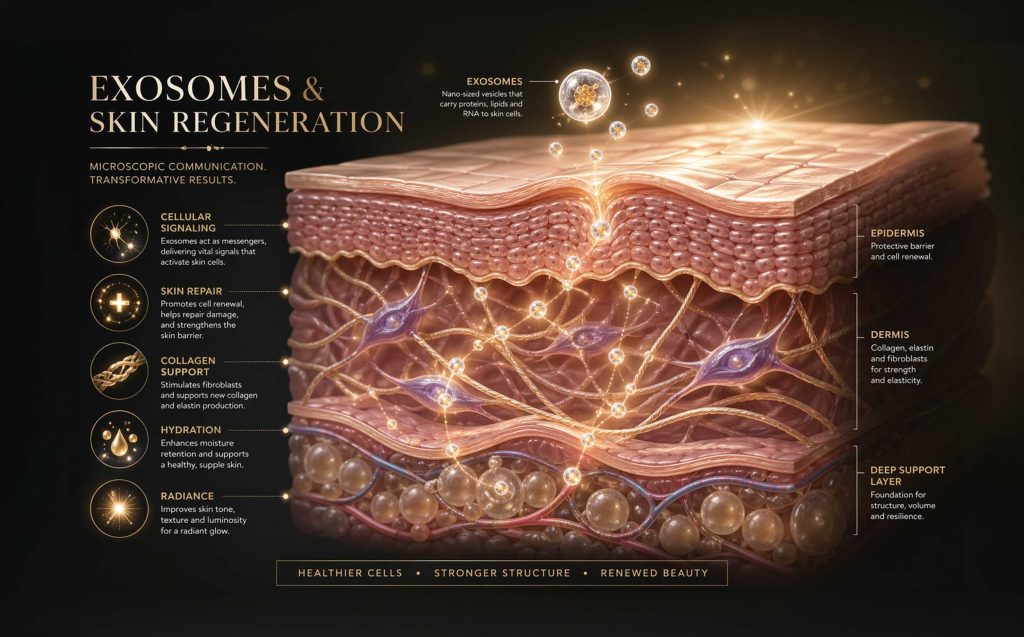
Exosomes are tiny extracellular vesicles released by cells. In simple terms, they are microscopic messengers. They carry bioactive signals from one cell to another, helping tissues coordinate repair, regulate inflammation, and maintain balance.
In the body, communication is everything. Cells do not work in isolation. They respond to signals, instructions, and environmental cues. Exosomes are part of that communication network. They help deliver information that influences how cells behave, especially in processes linked to regeneration and recovery.
That is what makes them so interesting in aesthetic medicine. Skin aging is not only about what we see in the mirror. It is also about slower cellular activity, weaker collagen support, more visible stress, and a reduced ability to recover efficiently. When people speak about exosomes in aesthetics, they are often speaking about this deeper layer of skin behavior.
Why they matter in skin rejuvenation?
The most beautiful skin does not always look "treated." It often looks healthy, calm, resilient, and alive. That kind of result usually comes from quality, not from excess. It comes from skin that is functioning well.
This is where exosomes entered the conversation so strongly. They are often discussed in relation to fibroblast support, collagen remodeling, tissue renewal, and post-procedure recovery. In other words, they are linked to the foundations of skin quality rather than surface correction alone.
That difference matters. A treatment that only adds temporary freshness may have a place. But a treatment concept built around regeneration speaks to something longer-term. It speaks to skin texture, elasticity, resilience, and the overall impression of health that patients increasingly want.
From hydration to regeneration
For years, hydration dominated the aesthetic world. And of course, hydration remains essential. Skin that is well hydrated looks smoother, softer, and more radiant. But hydration alone is no longer enough to define advanced care.
The industry has gradually moved toward regeneration. Patients are more informed now. They often ask for subtle outcomes, natural refinement, and stronger skin quality rather than obvious intervention. They want improvement that feels believable.
That shift helps explain the rise of exosome-based treatment concepts. They fit naturally into a modern aesthetic mindset: support the tissue, respect the biology, and aim for results that unfold with elegance rather than force.
Why exosomes feel different from older treatment narratives
Older aesthetic narratives often focused on replacing what was missing or covering what was visible. Exosomes belong to a newer story. They are part of a language built around signaling, regeneration, and skin intelligence.
That is one reason the topic feels so compelling. It suggests that rejuvenation does not always have to mean adding volume or aggressively resurfacing the skin. It can also mean creating better conditions for the skin to repair itself more effectively.
For practitioners, this opens the door to more refined protocols. For patients, it creates a more appealing emotional message: not changing the face, but helping the skin return to a healthier state.
Where EXODNA PLUS enters the picture
As the field grows, more professional formulations are being designed around this regenerative direction. One example is EXODNA PLUS, which sits within this category in a way that feels relevant to the current evolution of aesthetic medicine.
What makes the concept notable is that it does not present exosomes as a standalone story. Instead, it combines Exosomes, Sodium DNA (PDRN), and Hyaluronic Acid, bringing together several pathways that are often discussed in professional skin quality protocols.
Seen neutrally, this kind of formulation reflects a logical treatment philosophy. Exosomes are associated with cellular communication. PDRN is often linked to tissue repair and fibroblast support. Hyaluronic Acid contributes hydration and dermal comfort. Together, they create a more layered regenerative concept rather than a one-dimensional claim.
That is also why EXODNA PLUS can be mentioned naturally in the exosome discussion without sounding forced. It represents the direction the market is moving toward: combination systems that aim to support repair, hydration, and long-term skin quality at the same time.
Bring out your natural glow with Curology
At solmen va esser necessi far uniform grammatica, pronunciation e plu sommun paroles. Ma quande lingues coalesce, li grammatica del resultant lingue es plu simplic e regulari quam ti del coalescent lingues. Li nov lingua franca va esser plu simplic e regulari quam li existent Europan lingues pronunciation e li plu commun vocabules solmen va esser.
Why combination formulas are becoming more relevant
Real skin concerns rarely exist one by one. A patient may have dehydration, dullness, early laxity, barrier stress, and post-inflammatory changes all at once. This is why modern formulations increasingly combine multiple supportive mechanisms instead of relying on a single hero ingredient.
In that sense, products like EXODNA PLUS fit a broader clinical reality. The goal is not simply to spotlight exosomes as a fashionable ingredient, but to place them inside a more complete approach to skin regeneration.
This matters because the future of aesthetic medicine is unlikely to belong to isolated trends. It will belong to intelligent systems, thoughtful layering, and treatment concepts that understand the skin as a living, communicating tissue.
Exosomes and recovery after procedures
Another reason exosomes have captured so much interest is their connection to post-procedure care. In aesthetic practice, the recovery phase often influences the visible outcome just as much as the procedure itself.
After treatments such as microneedling, RF, fractional procedures, or laser-based interventions, practitioners are often looking for ways to support the skin as it calms, reorganizes, and rebuilds. Exosomes are increasingly discussed in this context because regenerative signaling feels especially relevant here.
This is also one of the settings in which a product like EXODNA PLUS may be viewed as particularly aligned with current practice, because its positioning speaks not only to rejuvenation, but also to support, repair, and skin quality restoration.
Why patients are drawn to the idea
Patients do not always know the molecular science behind exosomes, and they do not need to. What they understand is the promise behind the concept. They hear words like repair, regeneration, resilience, and skin quality, and these ideas resonate.
Today’s patient is often less interested in looking dramatically different and more interested in looking healthy, rested, luminous, and naturally well maintained. That is one reason exosomes have emotional power as well as scientific appeal.
They speak to a more modern kind of beauty: skin that does not look overworked, overfilled, or artificial, but quietly stronger and better.
So, are exosomes just a trend?
It is fair to ask the question, because aesthetics is full of trends. But exosomes feel different from many short-lived buzzwords because they are part of a larger movement that is not going away. The industry is clearly shifting toward regenerative thinking.
That does not mean every exosome claim should be accepted uncritically, and it certainly does not mean every product in the market is equal. But it does mean the conversation itself is important. It reflects a new standard in how rejuvenation is being understood.
And in that conversation, EXODNA PLUS stands as one example of how brands are translating the regenerative idea into practical professional formulations, combining exosomes with supportive ingredients in a way that reflects current clinical interest rather than empty hype.
Final thought
Exosomes matter because they point to something bigger than a fashionable ingredient. They point to a shift in mindset. A shift from surface-only correction to deeper support. From aggressive intervention to intelligent regeneration. From short-term effect to long-term skin quality.
That is why the subject continues to grow. It is not only about science. It is about direction. The direction of aesthetic medicine is becoming more refined, more thoughtful, and more focused on helping the skin behave like healthier skin.
And that is exactly why people keep reading, asking, and talking about exosomes. Because beneath the technical language, the idea is simple: better communication, better recovery, and better skin.